NBA Home vs Away Props: Factoring Location into Betting Lines
 Available in US
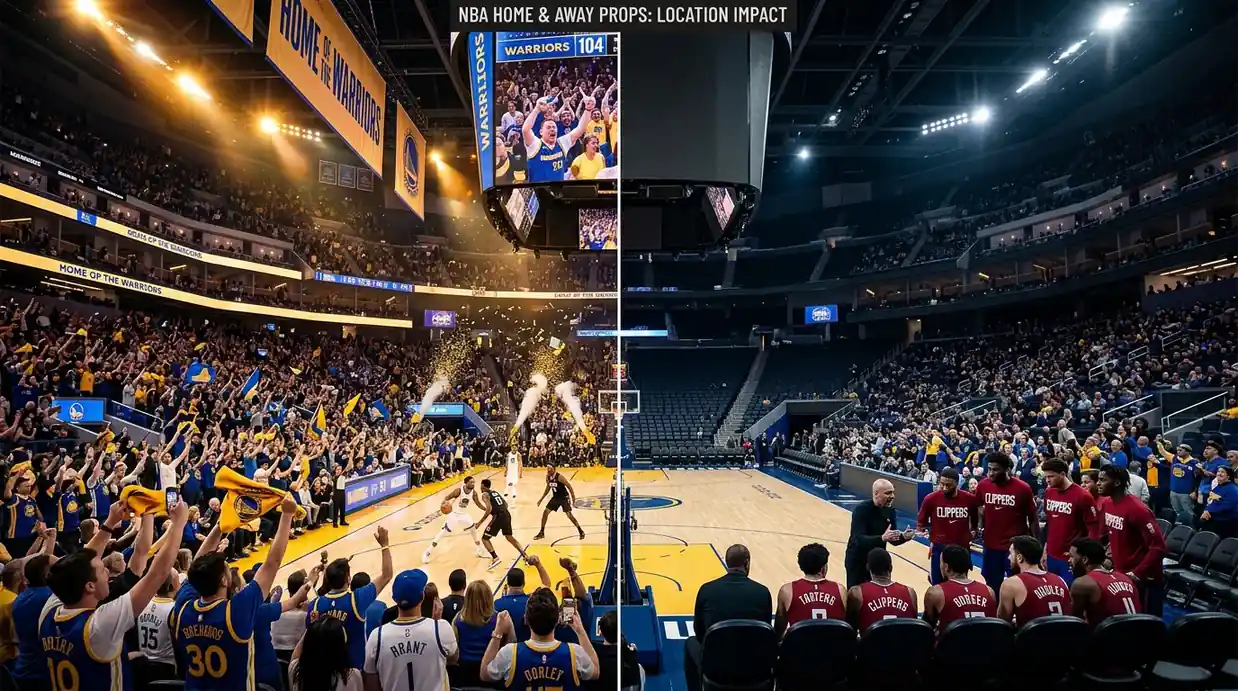
Most UK online gambling takes place from home – about 95% according to recent data. That statistic popped into my head last season while I watched a player I had bet struggle through an awful road performance. He was playing in Denver, altitude was clearly affecting him, and I had ignored the location entirely in my analysis. Home court advantage is not just about crowd noise. It encompasses travel, altitude, comfort, and routine disruption – all factors that move props outcomes in measurable ways.
I resisted home/away splits for years, dismissing them as small sample noise. Then I ran the numbers across thousands of prop outcomes and found consistent patterns. Road performances genuinely differ from home performances for most players, and props lines do not always adjust fully for this difference. Location analysis will not make every bet a winner, but ignoring it leaves money on the table.
Evaluating Home Court Metrics for NBA Props
Home teams win roughly 55-57% of NBA games historically, a margin that has compressed slightly in recent years but remains meaningful. That winning percentage reflects advantages that extend beyond game outcomes to individual player performance. The same player, in the same matchup, produces different numbers at home versus on the road.
Comfort and routine drive much of home court benefit. Players sleep in their own beds, follow familiar pregame routines, and perform in an environment they know intimately. The elimination of variables allows focus on performance rather than logistics. Road trips disrupt sleep, diet, and preparation in ways that accumulate over multi-game stretches.
Crowd energy affects effort and aggression. Players run harder, contest shots more vigorously, and push through fatigue when hometown fans respond to their effort. The psychological lift of positive crowd reaction is real even if difficult to quantify. Conversely, hostile road crowds can rattle players and referees alike.
Referees historically favour home teams slightly in foul calls and other judgement decisions. This effect has diminished with league oversight but has not disappeared entirely. Home players get marginally more favourable whistles, which translates to more free throw attempts and fewer foul trouble situations that limit minutes.
Analysing Home and Away Splits
Pull a player’s home versus away statistics and you will typically find differences across every category. Scoring tends to be 1-3 points higher at home. Shooting percentages improve slightly on familiar courts. Turnovers increase on the road as communication with teammates becomes harder in hostile environments.
Look at splits over at least 20 games in each setting to establish reliable patterns. Smaller samples produce noisy data that leads to false conclusions. Some players genuinely perform similarly regardless of location; others show dramatic home/away differences that persist across seasons. Identifying which category your target falls into matters for props analysis.
Recent form can override historical splits. A player on a road hot streak might outperform his typical away numbers. A player struggling at home might underperform despite the usual home advantage. Use splits as baseline adjustments while remaining open to current form suggesting different outcomes.
Consider the specific road environment rather than treating all road games equally. Playing in a quiet arena with sparse attendance differs from playing in raucous environments where crowd noise makes communication impossible. Late-season games against eliminated teams create different road conditions than playoff-calibre matchups against contenders.
Travel Fatigue and Its Effects
Cross-country travel creates fatigue that single time zone trips do not. A UK bettor booking flights understands this intuitively – flying from London to New York feels different than flying to Paris. NBA players face similar disparities. A West Coast team playing an East Coast game that tips at 7pm local time is playing at what feels like 4pm body time.
Long road trips accumulate fatigue beyond individual game effects. A team on the fourth game of a five-game road trip plays differently than a team making a single-game road swing. The fatigue compounds through disrupted sleep, dietary changes, and the mental strain of living out of hotels. Props for players deep into road trips should adjust downward.
Return trips also matter. A team flying home after a West Coast trip faces jet lag that one night of rest might not resolve. The first home game after extended travel often shows lingering fatigue effects even though the team has technically returned to comfortable surroundings.
Schedule spotting identifies these travel situations before the market fully prices them. Look for teams playing the second leg of back-to-backs after cross-country flights, teams on extended road trips, or teams playing early games after recent travel. These situations create performance drag that props lines sometimes underweight.
The Denver Altitude Factor
Denver’s mile-high altitude affects visiting players measurably. The thin air reduces oxygen availability, causing faster fatigue and reduced endurance. Players who fly in the day of a game feel the effects most acutely, though even arriving early does not fully acclimate visitors to the altitude.
Conditioning matters for altitude games. Well-conditioned athletes handle altitude better than those playing through fatigue or minor injuries. The Nuggets themselves are acclimated, giving them a significant home advantage that shows in their historical home winning percentage.
Fourth quarter performance tells the altitude story. Visiting teams often compete evenly through three quarters, then fade as oxygen debt accumulates. For props purposes, this means visiting players on tight lines might fall short in the final period when they would typically push over in other venues.
I apply automatic adjustments to road props at Denver – roughly 5% reduction from baseline projections for conditioning-dependent stats like points. This crude adjustment has improved my results on Denver road games enough to justify its inclusion in my standard process.
Home vs Away Props FAQ
Do NBA players perform better at home?
Yes, most players show measurably better performance at home across scoring, shooting percentage, and other metrics. The advantage stems from familiar environments, routine consistency, crowd support, and slight referee bias. Home/away splits typically show 1-3 points of scoring difference and a few percentage points of shooting improvement at home.
How does altitude affect props in Denver?
Denver’s mile-high elevation reduces oxygen availability for visiting players, causing faster fatigue and reduced endurance. The effect intensifies in fourth quarters as oxygen debt accumulates. Road players at Denver should have props projections reduced by roughly 5% compared to other road games to account for altitude impact.
Should I factor in travel for props?
Yes, particularly for cross-country travel and extended road trips. Jet lag, disrupted routines, and accumulated fatigue affect performance in ways that props lines sometimes underweight. Teams on the fourth game of five-game road trips, or playing back-to-backs after long flights, face performance drags worth incorporating into your analysis.
Location as One Piece of the Puzzle
Home/away analysis slots into a broader framework rather than standing alone. A player at home with a favourable matchup and good recent form is a stronger bet than one who only has home court working for him. A player on the road with altitude challenges but facing a terrible defence might still clear his line despite location disadvantages.
The goal is accurate projection, and location provides one input toward that goal. Ignore it and you miss consistent patterns that affect outcomes. Overweight it and you miss the player-specific and matchup factors that matter more. Balance location with other analysis, use it to adjust baseline projections, and treat it as a refinement rather than a primary betting thesis.
Written by the editors at nba Bets Props.